Tuesday, May 24, 2011

#106: SLSC - Day 16

Day 16: Wildlife

The wildlife of Sierra Leone is very diverse due to the variety of different habitats within the country. Sierra Leone is home to approximately 2090 known higher plant species, 147 known species of mammals, 172 known breeding bird species, 67 known reptile species, 35 known amphibian species and 99 known species of fish. Sierra Leone has around 750 species of butterflies. Including one of the largest butterflies the Giant African swallowtail whose wingspan can be up to 25 cm.

Sierra Leone has 15 identified species of primates that include bushbaby, monkeys and a great ape, the Common Chimpanzee which is Sierra Leone's largest primate. Chimpanzees are found across the country with the 2010 chimpanzee census estimated a wild population in excess of 5500 more then double the number previously thought to live in the country. This is the second largest population of the endangered subspecies of Western chimpanzee, after Guinea, with the largest density in the Loma area, 2.69 individuals per km2, and the Outamba, with 1.21 individuals per km2. There are several species of whales and the African Manatee in the waters of Sierra Leone. The Manatee is an endangered species and lives in the rivers and estuaries of Sierra Leone especially around Bonthe. Mammals found in Sierra Leone include hippotamus, African Bush Elephant, and Bongo Elephant.

Sierra Leone has over 630 known species of bird ten of which are considered endangered including Rufous Fishing-owl and Gola Malimbe. On the coastal area there are several important sites for migratory ducks and wading birds from the palearctic area. Some of these birds are African Harrier Hawk, Black-collared Lovebird, Blue-headed Wood-dove, Iris Glossy-starling, White-breasted Guineafowl, and White-necked Rockfowl.

There are 67 known species of reptiles, three of which are endangered, in Sierra Leone including several large reptiles. There are three species of Crocodiles, the Nile Crocodile, the Slender-snouted Crocodile which lives in forest streams, Dwarf crocodile found in mangrove swamps. All the species of sea turtles live in the waters of Sierra Leone with the Green Turtle and Leatherback Turtle laying eggs on the shores including on Sherbro Island and Turtle Island. Common species of lizard include the large Nile monitor, the Agama seen around settlements, the Brook's House Gecko often lives inside houses, and Chamaeleos.

Wild flora vegetation types include the lowland moist and semi-deciduous forests, part of the Western Guinean lowland forests, inland valley swamps, wooded savannah, bolilands and mangrove swamps. There are about 2,000 know species of plants with 74 species only occurring only in Sierra Leone. Primary rainforest used to cover around 70% of Sierra Leone in the mid 2000s this had reduced to around 6%. Common species include:
  • Red Mangrove which grows in swamp areas along the western coast.
  • Oil Palm used for palm oil and palm wine.
  • Cotton Tree one of which is a historical symbol of Freetown.
  • Red ironwood tree.


P.S.: This information was derived from Wikipedia.

Monday, May 23, 2011

#105: SLSC - Day 15

Day 15: Geography and climate

Sierra Leone is located on the west coast of Africa, lying mostly between latitudes 7° and 10°N (a small area is south of 7°), and longitudes 10° and 14°W. The country is bordered by Guinea to the north and northeast, Liberia to the south and southeast, and the Atlantic Ocean to the west.

Sierra Leone has a total area of 71,740 km2 (27,699 sq mi), divided into a land area of 71,620 km2 (27,653 sq mi) and water of 120 km2 (46 sq mi). The country has four distinct geographical regions. In eastern Sierra Leone the plateau is interspersed with high mountains, where Mount Bintumani reaches 1,948 m (6,391 ft), the highest point in the country. The upper part of the drainage basin of the Moa River is located in the south of this region.

The center of the country is a region of lowland plains, containing forests, bush and farmland, that occupies about 43% of Sierra Leone's land area. The northern section of this has been categorised by the World Wildlife Fund as part of the Guinean forest-savanna mosaic ecoregion, while the south is rain-forested plains and farmland. In the west Sierra Leone has some 400 km (249 mi) of Atlantic coastline, giving it both bountiful marine resources and attractive tourist potential. The coast has areas of low-lying Guinean mangroves swamp. The national capital Freetown sits on a coastal peninsula, situated next to the Sierra Leone Harbour, the world's third largest natural harbour.

The climate is tropical, with two seasons determining the agricultural cycle: the rainy season from May to November, and a dry season from December to May, which includes harmattan, when cool, dry winds blow in off the Sahara Desert and the night-time temperature can be as low as 16 °C (60.8 °F). The average temperature is 26 °C (78.8 °F) and varies from around 26 °C (78.8 °F) to 36 °C (96.8 °F) during the year.

Sunday, May 22, 2011

#104: SLSC - Day 14

Day 14: Early colonies

In 1787 a settlement was founded by in Sierra Leone in what was called the "Province of Freedom". A number of "Black Poor" arrived off the coast of Sierra Leone on 15 May 1787, accompanied by some English tradesmen. Many of the "black poor" were African Americans, who had been given their freedom after seeking refuge with the British Army during the American Revolution, but also included other West Indian, African and Asian inhabitants of London. After establishing Granville Town, disease and hostility from the indigenous people eliminated the first group of colonists and destroyed their settlement. A second Granville Town was established by 64 remaining colonists.

Through the impetus of Thomas Peters, the Sierra Leone Company was established to relocate 1,196 Black Americans, most of whom had escaped enslavement in the United States by seeking protection with the British Army during the American Revolution. They had been given land in Nova Scotia and a few had died from the harsh winters there. These colonists built the second (and only permanent) Colony of Sierra Leone and the settlement of Freetown on March 11, 1792. In Sierra Leone they were called the Nova Scotian Settlers or 'Nova Scotians' but were commonly known as the Settlers. The Settlers built Freetown and introduced architectural styles from the American South as well as Western fashion and American courtesy. In the 1790s, the Settlers voted for the first time in elections, as did women. The Sierra Leone Company refused to allow the settlers to take freehold of the land. Some of the Settlers revolted in 1799. The revolt was only put down by the arrival of over 500 Jamaican Maroons, who also arrived via Nova Scotia. In 1800, Jamaican Maroons from Trelawny Town, Jamaica were settled via Nova Scotia.

After sixteen years of the running the Colony, the Sierra Leone Company was formed into the African Institution. The Institution met in 1807 to achieve more success by focusing on bettering the local economy, but it was constantly split between those British who meant to inspire local entrepreneurs and those with interest in the Macauley & Babington Company which held the (English) monopoly on Sierra Leone trade.

Beginning in 1808 (following the abolition of the slave trade in 1807), thousands of formerly enslaved Africans were liberated in Freetown. Most of these Liberated Africans or 'Recaptives' chose to remain in Sierra Leone. Cut off from their homes and traditions, the Liberated Africans assimilated the Western styles of Settlers and Maroons and built a flourishing trade of flowers and beads on the West African coast. These returned Africans were from many areas of Africa, but principally the west coast. During the 19th century many black Americans, Americo Liberian 'refugees', and particularly West Indians immigrated and settled in Freetown creating a new ethnicity called the Krio.

P.S.: The information given above was derived from Wikipedia.

Born Sierra Leonean - JayArr

Saturday, May 21, 2011

#103: SLSC - Day 13

Day 13: Leone

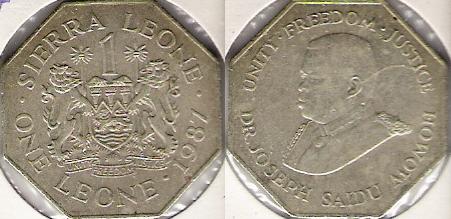
The Leone is the currency of Sierra Leone. It is subdivided into 100 cents. The ISO 4217 code is SLL and the Leone is abbreviated as Le placed before the amount. The leone was introduced in 1964. It replaced the British West African pound at a rate of 1 pound = 2 leones (i.e., 1 leone = 10 shillings).

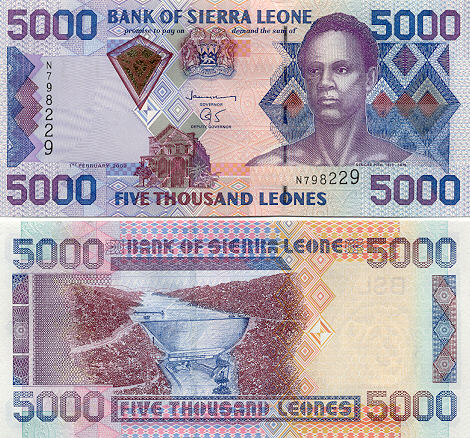
In 1964, the Bank of Sierra Leone introduced notes in denominations of 1, 2 and 5 leones. 50 cents notes were added in 1979, followed by 10 leones in 1980 and 20 leones in 1982. 100 leones notes were introduced in 1988, followed by 500 leones in 1991, 1000 and 5000 leones in 1993, 2000 leones in the year 2000 and 10,000 Leone in 2004.

Prior to June 2010, bank notes in circulation were 500, 1000, 2000, 5000 and 10,000 leones. 10,000 leones notes were in circulation for less than ten years and were infrequently encountered. This meant that most transactions took place in bundles of 5000 leones notes.

In June 2010, the Bank of Sierra Leone issued new notes which were slightly smaller in size than the earlier series and intended to be more secure and durable. The new bank notes are: Le10,000, Le5,000, Le2,000 and Le1,000. Coins are still used, but because of their low value are less common.
Because of inflation, a 20,000 leone banknote has been suggested.


Friday, May 20, 2011

#102: SLSC - Day 12

Day 12: SaLone Style Magazine

SaLone Style magazine was founded by Veronica Conteh in June 2009; it is the first ever magazine that focuses on fashion, beauty and style of Sierra Leoneans as well as Africa as a whole. On September 25, 2009, the magazine was launched to an audience of very important people in the African community in the UK.

To know more about SaLone Style magazine, visit their website (http://www.salonestyle.com/).


#101: Song Challenge - Day 30

Day 30: Your favorite song(s)
Sierra Leone gospel songs

Thursday, May 19, 2011

#100: SLSC - Day 11

Day 11: Mineral resources

Sierra Leone is rich in mineral resources, possessing some of the most commercially valuable mineral reserves in the world, many of which are found in significant quantities. The country has relied on mining, especially diamonds, for its economic base; it is among the top 10 diamond producing nations in the world, and mineral exports remain the main foreign currency earner. Sierra Leone is also among the largest producers of titanium and bauxite, and a major producer of gold. The country has one of the world's largest deposits of rutile. Despite this natural wealth, the vast majority of its people live in poverty.

Due to the fact that Sierra Leone is rich in minerals, the country has relied on mining, especially diamonds, for its economic base. The country is among the top 10 diamond producing nations in the world. Mineral exports remain the main foreign currency earner. Sierra Leone is a major producer of gem-quality diamonds. Though rich in diamonds, it has historically struggled to manage their exploitation and export.

Annual production of Sierra Leone's diamond estimates range between $250–300 million US$. Some of that is smuggled, where it is possibly used for money laundering or financing illicit activities. Formal exports have dramatically improved since the civil war with efforts to improve the management of them having some success. In October 2000, a UN-approved certification system for exporting diamonds from the country was put in place and led to a dramatic increase in legal exports. In 2001, the government created a mining community development fund (DACDF), which returns a portion of diamond export taxes to diamond mining communities. The fund was created to raise local communities' stake in the legal diamond trade.

Sierra Leone is also known for its blood diamonds that were mined and sold to diamond conglomerates during the civil war, in order to buy the weapons that fuelled the atrocities of the civil war. In the 1970s and early 1980s, economic growth rate slowed because of a decline in the mining sector and increasing corruption among government officials.

Sierra Leone has one of the world's largest deposits of rutile, a titanium ore used as paint pigment and welding rod coatings. Sierra Rutile Limited, owned by a consortium of United States and European investors, began commercial mining operations near the city of Bonthe, in the Southern Province, in early 1979. It was then the largest non-petroleum US investment in West Africa. The export of 88,000 tons realized $75 million in export earnings in 1990. In 1990, the company and the government made a new agreement on the terms of the company's concession in Sierra Leone. Rutile and bauxite mining operations were suspended when rebels invaded the mining sites in 1995, but exports resumed in 2005. The new Mines and Minerals Act was passed by Parliament in November 2009, which aimed to improve concessions management in the Ministry of Mineral Resources. Sierra Leone is an EITI candidate country.


P.S.: Some of this information was gotten from Wikipedia.

#99: Song Challenge - Day 29

Day 29: A song from your childhood
Nah mi Jesus

#98: End of the world

So with all the uproar about the world coming to an end that I've been hearing lately, I wanted to share these awesome videos made by one of my fave Youtubers, JaeTracie. Watch them and share what you think.

Wednesday, May 18, 2011

#97: SLSC - Day 10

Day 10: Rujizzle reflects

Lately I've started thinking of how much Sierra Leonean pride I have and get excited about my country. It got me thinking if I lived in the country, if my pride and joy for Sierra Leone would have been the same. When I was living in Sierra Leone, I absolutely loved the country and culture but I do not remember being this patriotic at all. But on the other end, I lived in Sierra Leone when I was younger and below age 12, so there was not much for me to have done which were life-changing actions for the country. However with the resources technology has provided in today's society, younger kids can achieve excellence and age is not an issue.

My big curiousity right now is that if I currently lived in Sierra Leone, if I'd have been so passionate about the nation as I am living outside the nation. I have always had pride for my country because I participated in a lot of social and cultural events that told Sierra Leonean stories in forms of dance and plays, but during those times I never felt a need to but purely did it for entertainment purposes. But now, I have come to realize that several things I do for Sierra Leone are not only for entertainment purposes but also educational purposes. A part of me sometimes feels obligated to tell the stories of Sierra Leoneans, and I really do not have a problem with that. I wonder if I am the only person part of the diaspora that feels that way.

Yes, I still do performances and educational sessions about Sierra Leone and enjoy them just as I did when I was 10, but now I have intentions of also educating the world about my home and telling alternative stories of my country besides the ones that are told on CNN and other international sources.

However, if there is one thing I'd like to change about the nation with regards to this consciousness-raising is that patriotism and nation-pride need to be discussed more among the people, especially the younger generation in the country. I felt that I was rarely told of how blessed and great Sierra Leone was when I lived there, and I only came to realize what a great nation it is after I left. Yes, Sierra Leone is not a country that one can live in and think of it as a bed of roses because there are things that need work to be done, however, the things we do have are blessings and we must appreciate them because other countries long and wish to have them.

Sierra Leone gospel songs

#96: Song Challenge - Day 28

Day 28: A song that makes you thankful
Kirk Franklin - Imagine me

Tuesday, May 17, 2011

#95: SLSC - Day 9

Day 9: Provinces and districts

The Republic of Sierra Leone is composed of four (4) regions which are the Northern Province, Southern Province, Eastern Province, and Western Area. The Northern, Southern, and Eastern Provinces are divided into 12 districts, and these districts are divided into 149 chiefdoms. There are 13 district councils, one for each of the 12 districts and another for the Western rural area, and six municipalities each with a council, Freetown, Bo, Bonthe, Kenema, Koidu and Makeni. Freetown is the capital, largest city, and also economic and financial center of the Republic of Sierra Leone. The other major cities are: Bo, Kenema, Koidu town, and Makeni.

DISTRICTS - CAPITALS
Northern Province
Bombali - Makeni
Koinadugu - Kabala
Port Loko - Port Loko
Tonkolili - Magburaka
Kambia - Kambia

Eastern Province
Kenema - Kenema
Kono - Koidu town
Kailahun - Kailahun

Southern Province
Bonthe - Mattru Jong
Pujehun - Gandorhun
Moyamba - Moyamba

Western Area
Western Area Urban - Freetown
Western Area Rural - Waterloo

#94: Song Challenge - Day 27

Day 27: A song that you wish you could play on an instrument
Ron Kenoly - Heal their land

Monday, May 16, 2011

#93: SLSC - Day 8

Day 8: Political parties

There are 10 recognized political parties in Sierra Leone, but there are usually 3-4 parties present in general Presidential elections. The most popular political parties are All People's Congress, Sierra Leone People's Party, and People's Democratic Party. In Sierra Leone, each presidential term consists of five (5) years for a political party and president to remain in power, but is allowed to run for re-election after the president's term ends.

In the past years, Sierra Leone has had two recognized presidential elections which took place in 2002 (President Ahmed Tejan Kabbah) and 2007 (won by President Ernest Bai Koroma). Past presidents of Sierra Leone are:
Justice Christopher Okoro Cole (non-party) - served as president for two days
President Siaka Stevens (All People's Congress)
President Joseph Saidu Momoh (All People's Congress)


The full list of political parties in Sierra Leone are:
All People's Congress - reigning party with President Koroma
Sierra Leone People's Party - last reigning party with President Ahmed Tejan Kabbah
Grand Alliance Party
Peace and Liberation Party
People's Democratic Party
People's Movement for Democratic Change
Revolutionary United Front
United National People's Party
Young People's Party
National Alliance Democratic Party

#92: Song Challenge - Day 26

Day 26: A song that you think is cute

Love is blind - Heyden Adama Bangura

Sunday, May 15, 2011

#91: SLSC - Day 7

Day 7: Cry Freetown

Cry Freetown is a documentary that was broadcasted on CNN International in 2000 made by Sorious Samura. Sorious is a Sierra Leonean journalist and filmmaker. This documentary shows detailed accounts of the atrocities and damages that were caused by the 10-year civil war in Sierra Leone, as well as the battle for Freetown in January 2009.

For more information about Cry Freetown, visit the website.

#90: Song Challenge - Day 25

Day 25: A song that makes you laugh
Borbor bele - Emmerson

Saturday, May 14, 2011

#89: SLSC - Day 6

Day 6: Dr. Oloh


Dr. Oloh is one of the pioneering Sierra Leonean musicians who played the music genre of Gumbay. Gumbay music consists of mostly African instruments with some Western instruments, and also spoken-words which narrated a story. Gumbay music is popularly played in gatherings consisting of the Creole tribal group in Freetown. It is widely played in weddings, birthdays, baby naming ceremonies, and other social gatherings. Dr. Oloh is popularly known for his Afropop and Jazz beats. His songs are predominantly sang in krio.


Real name: Oloh Israel Olufemi Cole

Born: March 20, 1944 in Leicester, Sierra Leone

Born to a Creole father and a Nigerian mother

Died: October 13, 2007


Music by Dr. Oloh and his band


#88: Song Challenge - Day 24

Day 24: A song that you want to play at your child's party
Bebe DJ - Enfant poli

Friday, May 13, 2011

#87: SLSC - Day 5

Day 5: Dr. Oloh


Dr. Oloh is one of the pioneering Sierra Leonean musicians who played the music genre of Gumbay. Gumbay music consists of mostly African instruments with some Western instruments, and also spoken-words which narrated a story. Gumbay music is popularly played in gatherings consisting of the Creole tribal group in Freetown. It is widely played in weddings, birthdays, baby naming ceremonies, and other social gatherings. Dr. Oloh is popularly known for his Afropop and Jazz beats. His songs are predominantly sang in krio.


Real name: Oloh Israel Olufemi Cole

Born: March 20, 1944 in Leicester, Sierra Leone

Born to a Creole father and a Nigerian mother

Died: October 13, 2007


Music by Dr. Oloh and his band


Related Posts Plugin for WordPress, Blogger...