Tuesday, May 31, 2011

#115: SLSC - Day 23

Day 23: Freetown


Freetown is the capital and largest city of Sierra Leone, a country in west Africa. It is a major port city on the Atlantic Ocean located in the Western Area of the country and with a population of 1.2 million. The city is the economic, financial, and cultural center of Sierra Leone. Most of the country's largest corporations as well as the majority of international companies have located their headquarters' home offices in Freetown. The city's economy revolves largely around its harbor - occupying a part of the estuary of the Sierra Leone River in one the world's largest natural deep water harbours. Queen Elizabeth II Quay is capable of receiving oceangoing vessels and handles Sierra Leone's main exports.


Freetown is home to one of the country's two main universities, the Fourah Bay College, the oldest university in West Africa, founded in 1827. The university not only played a key role in Sierra Leone’s colonial history, but also a key role in the history of the English-speaking West-African nations. Freetown is home to dozens of national newspapers and the country's national television and radio stations, the Sierra Leone Broadcasting Services (SLBS), is based in Freetown, although it also has regional headquarters in the cities of Bo, Kenema and Makeni.


Freetown is home to significant numbers of all of the country's ethnic groups, although it is the primary home of the Sierra Leone Creole people (descendant of freed Liberated Africans, African-Americans and West Indians). Currently the Temne people form the largest ethnic group in the city, though the Krio people are still the most dominant ethnic group in the city politically. Many of the Freetown local city council city are held by ethnic Creoles, including the mayor of Freetown, a position mainly held by Creoles or Europeans since the city was founded. As in virtually all parts of Sierra Leone, the Krio language (a native language of the Creole people who only make up 5% of country's population) is by far the most widely spoken language in the city. The Krio language is spoken as a lingua franca by the entire population in the city of Freetown.


The city of Freetown was founded by Lieutenant John Clarkson and freed American slaves, called the Nova Scotian Settlers, who were transported to Sierra Leone by the Sierra Leone Company in 1792. Freetown is the oldest capital to be founded by freed American slaves, having been founded thirty years before Monrovia, Liberia. The oldest part of Freetown is Settler Town which was established by the Nova Scotians in 1792, after their namesake 'The Settlers'. The Maroons founded Maroon Town in 1800, thereby establishing another historical area in Freetown. The suburbs of Freetown were founded by the Liberated Africans between 1809–1827, and presently they are the most affluent areas of the Freetown peninsula.


Lungi International Airport serves Freetown and the rest of Sierra Leone. It is located in the city of Lungi, Port Loko District, across the river from Freetown. Lungi International Airport serves as the primary airport for domestic and international travel to and from Sierra Leone.

#114: The R-word

Monday, May 30, 2011

#113: SLSC - Day 22

Day 22: The Cotton Tree


The Cotton Tree is an historic symbol of Freetown, the capital city of Sierra Leone. According to legend, the "Cotton Tree" gained importance in 1792 when a group of former African American slaves, who had gained their freedom by fighting for the British during the American War of Independence, settled the site of modern Freetown. These Black Loyalist settlers, called "Nova Scotians" or "Navitians" in Sierra Leone, founded Freetown on March 11th 1792. According to tradition, they landed on the shoreline and walked up to a giant tree just above the bay and held a thanksgiving service there, gathering around the tree in a large group and praying and singing hymns to thank God for their deliverance to a free land. Its exact age is unknown, but it is known to have existed in 1787.


Today, a huge Cotton Tree stands in the oldest part of Freetown near the Supreme Court building, music club building and the National Museum. Sierra Leonians believe that this is very tree was where the "Nova Scotian settlers prayed more than two hundreds years ago, and they regard it as the symbol of their capital city. Sierra Leonians still pray and make offerings to the ancestors for peace and prosperity beneath the great ancestry Cotton Tree. This was especially true during the Sierra Leone civil war (1991-2002).


Sunday, May 29, 2011

#112: SLSC - Day 21

Day 21: Coat of arms


The coat of arms of Sierra Leone (along with the flag), were developed by the College of Arms and granted in 1960. The shield on the arms depicts a lion beneath a zigzag border, representing the Lion Mountains, after which the country was named. It also shows three torches which are meant to symbolize peace and dignity. At the base are wavy bars depicting the sea. The supporters of the shield are lions, similar to those on the colonial badge. The three main colours from the shield - green, white and blue - were used to form the flag. The green represents agricultural and natural resources, the blue represents the Harbour of Freetown and the white represents unity and justice. At the bottom of the shield, the national motto can be seen.

#111: Healthy Lifestyle For Her

"Healthy Lifestyle For Her" is sponsored by my philanthropy, When You Believe Foundation. It is a FREE and OPEN event.

Saturday, May 28, 2011

#110: SLSC - Day 20

Day 15: Sierra Theatre Productions

Sierra Theatre Productions is the first Sierra Leonean performing arts troupe in the United States of America which was started by Mr. David Buarkei Vandy. For more information about Sierra Theatre Productions, visit their website (http://www.stproduction.net/). STP comprises of David B. Vandy; gospel singer, Giileh; Antonia Akpan; Foday Kargbo; Ibrahim Conteh; and many more amazing actors and actresses.

Their upcoming production is called "Let Me Die Alone: The Life and Times of Madam Yoko;" which is written by Kolossa John Kargbo, and directed by David B. Vandy. In addition, I am proud to say that I am part of this play, and I am very excited to be doing theater performances again just as I used to when I was attending school in Sierra Leone and Nigeria.

Friday, May 27, 2011

#109: SLSC - Day 19

Day 19: Bai Bureh


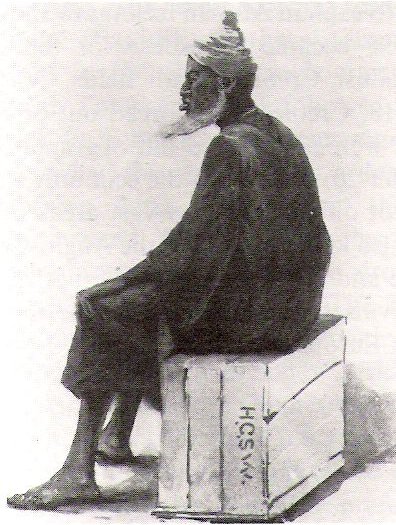
Bai Bureh (February 15, 1840 – August 24, 1908) was a Sierra Leonean ruler and military strategist who led the Temne and Loko uprising against British rule in 1898 in Northern Sierra Leone. Bai Bureh was born in Kasseh, a village near Port Loko in Northern Sierra Leone. His first name, Bai, means Chief in the Temne language. Bureh's father was an important Loko war-chief and his mother was a Temne trader from Makeni. When Bureh was a young man his father sent him to the small village of Gbendembu in northern Sierra Leone, where he was trained to become a warrior.


As a ruler, Bureh never wanted to cooperate with the British who were living in the capital city of Freetown. Bai Bureh refused to recognise a peace treaty the British had negotiated with the Limba without his participation; and on one occasion, his warrior fighters raided the British troops across the border into French Guinea. On January 1, 1893, the British colonials instituted a "Hut Tax" in Sierra Leone. This tax was issued throughout British-controlled Africa. The tax could be paid in either money, grain, stock or labor. Many Africans had to work as laborers to pay the tax. The Hut Tax enabled the British to build roads, towns, railways and other infrastructure amenities in British-controlled Sierra Leone.


Bai Bureh refused to recognise the hut tax that the British had imposed. He did not believe the Sierra Leonean people had a duty to pay taxes to foreigners and he wanted all British to return to Britain and let the Sierra Leoneans solve their own problems. After refusing to pay his taxes on several occasions, the British issued a warrant to arrest Bureh. When the British Governor to Sierra Leone, Sir Frederic Cardew, offered the princely sum of one hundred pounds as a reward for his capture, Bai Bureh reciprocated by offering the even more staggering sum of five hundred pounds for the capture of the governor. In 1896, Bureh declared war on British in Sierra Leone. The war later became known as the Hut Tax War of 1898.


The significance of Bai Bureh's war against the British is not a matter of whether he won or lost the war but that a man who had none of what could be called formal military training was able to show that for a significant number of months he was able to take on the British who were very proud of their great military successes across the globe. The British troops were led by officers trained at the finest military academies where war is studied in the same way that one studies a subject at university. The fact that Bai Bureh was not executed after his capture has led some historians to claim that this was in admiration for his prowess as an adversary to the British.


The tactics employed by Bai Bureh in his fight against the British are very much the forerunner of tactics employed by guerilla armies worldwide. At the time these tactics were very revolutionary and he "succeeded" for the good reason he had expert knowledge of the terrain across which the war took place. Bai Bureh had pursued the war not just with sound military brain but also a sense of humour. When Governor Cardew had offered the princely sum of 100 pounds as a reward for his capture, Bai Bureh had reciprocated by offering the even more staggering sum of five hundred pounds for the capture of the Governor.
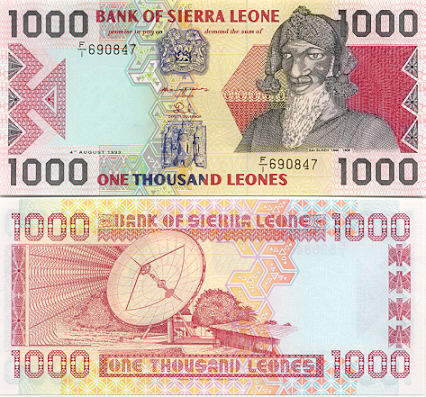
Many Sierra Leoneans view Bai Bureh today as the greatest man to ever come out of the country. There is a very large Statue of Bai Bureh in central Freetown. He pictured on several Sierra Leonean paper bill. A Sierra Leonean professional football club called the Bai Bureh Warriors from Port Loko is named after him.

Thursday, May 26, 2011

#108: SLSC - Day 18

Day 18: Mammy Yoko


Mammy Yoko or Madam Yoko (ca. 1849–1906) was a leader of the Mende people in Sierra Leone. Combining advantageous lineage, shrewd marriage choices and the power afforded her from the secret Sande society, Yoko became a leader of considerable influence. She expanded the Mende Kingdom and at the time of her death, she was the ruler of the vast Kpa Mende Confederacy.


Madam Yoko, originally called Soma, was born around 1849 in the Gbo Chiefdom. She changed her name to Yoko at her Sande initiation ceremony, during which time she became known for her graceful dancing. Yoko's first marriage, which was unsuccessful, was to a man named Gongoima. After leaving Gongoima, Yoko's second husband was Gbenjei, Chief of Taiama. Although Yoko remained childless, Gbenjei made her his head wife, giving her economic power within her household.


Following Gbenjei's death, Yoko married Gbanya Lango. In 1875, Gbanya was detained by British colonial officials in Taiamawaro. Yoko went directly to Governor Rowe to appeal for her husband's release. Rowe was impressed with Yoko's appeal and Gbanya was flogged, and then released. Following this incident, Gbanya made Yoko his head wife and began sending her on diplomatic missions. With the Sande, Yoko was able to wield significant power, not only amongst women, but Mende society as a whole. As a leader in this secret women's society, she made political alliances and took younger initiates as "wards" — later marrying them into other lineages. In 1878, following her third husband's death, Yoko became the chief of Senehun. By 1884 she was officially recognised as "Queen of Senehun". This recognition came not only from her own people, but also from the British. She died in 1906, rumoured to have committed suicide. Having no descendants of her own, she was succeeded by her brother Lamboi.

Wednesday, May 25, 2011

#107: SLSC - Day 17

Day 17: Fourah Bay College


Fourah Bay College (founded in 1827 as the first western-style university in West Africa) is the oldest university college in West Africa. It is located atop Mount Aureol in Freetown, Sierra Leone. It is a constituent college of the University of Sierra Leone (from 1966 to 2005) and was formerly affiliated with Durham University (from 1876-1967).


Established in 1827 as an Anglican missionary school (by the Church Missionary Society), Fourah Bay College soon became a magnet for Creoles and other Africans seeking higher education under the British Empire, especially in the fields of theology and education. It was the first western-style university in West Africa. Under colonialism, Freetown was known as the "Athens of Africa" as an homage to the college.
The first black principal of the university was an African American missionary, Reverend Edward Jones from South Carolina in the United States. Lamina Sankoh was a prominent early academic; Francis Heiser was principal from 1920 to 1922.Abioseh Nicol was the first Sierra Leonean born administrator in 1966.


The faculties of this university are:
  • Faculty of Arts
  • Faculty of Engineering
  • Faculty of Pure and Applied Sciences
  • Faculty of Social Sciences and Law
The insititutes of this university are:
  • Institute of Adult Education and Extra-Mural Studies
  • Institute of African Studies
  • Institute of Marine Biology and Oceanography
  • Institute of Population Studies
  • Institute of Library and Archive Studies and Mass Communications
Some notable alumni of this university are:
  • His Excellency President Ernest Bai Koroma
  • Zainab Bangura
  • Alexander Babatunde Akinyele
  • Madam Ella Koblo Gulama
  • Sir Milton Margai
  • Dr. Kadi Sesay
  • Kojo Botsio
  • Henry Rawlingson Carr
  • Samuel Ajayi Crowther
  • John Karefa-Smart

Tuesday, May 24, 2011

#106: SLSC - Day 16

Day 16: Wildlife

The wildlife of Sierra Leone is very diverse due to the variety of different habitats within the country. Sierra Leone is home to approximately 2090 known higher plant species, 147 known species of mammals, 172 known breeding bird species, 67 known reptile species, 35 known amphibian species and 99 known species of fish. Sierra Leone has around 750 species of butterflies. Including one of the largest butterflies the Giant African swallowtail whose wingspan can be up to 25 cm.

Sierra Leone has 15 identified species of primates that include bushbaby, monkeys and a great ape, the Common Chimpanzee which is Sierra Leone's largest primate. Chimpanzees are found across the country with the 2010 chimpanzee census estimated a wild population in excess of 5500 more then double the number previously thought to live in the country. This is the second largest population of the endangered subspecies of Western chimpanzee, after Guinea, with the largest density in the Loma area, 2.69 individuals per km2, and the Outamba, with 1.21 individuals per km2. There are several species of whales and the African Manatee in the waters of Sierra Leone. The Manatee is an endangered species and lives in the rivers and estuaries of Sierra Leone especially around Bonthe. Mammals found in Sierra Leone include hippotamus, African Bush Elephant, and Bongo Elephant.

Sierra Leone has over 630 known species of bird ten of which are considered endangered including Rufous Fishing-owl and Gola Malimbe. On the coastal area there are several important sites for migratory ducks and wading birds from the palearctic area. Some of these birds are African Harrier Hawk, Black-collared Lovebird, Blue-headed Wood-dove, Iris Glossy-starling, White-breasted Guineafowl, and White-necked Rockfowl.

There are 67 known species of reptiles, three of which are endangered, in Sierra Leone including several large reptiles. There are three species of Crocodiles, the Nile Crocodile, the Slender-snouted Crocodile which lives in forest streams, Dwarf crocodile found in mangrove swamps. All the species of sea turtles live in the waters of Sierra Leone with the Green Turtle and Leatherback Turtle laying eggs on the shores including on Sherbro Island and Turtle Island. Common species of lizard include the large Nile monitor, the Agama seen around settlements, the Brook's House Gecko often lives inside houses, and Chamaeleos.

Wild flora vegetation types include the lowland moist and semi-deciduous forests, part of the Western Guinean lowland forests, inland valley swamps, wooded savannah, bolilands and mangrove swamps. There are about 2,000 know species of plants with 74 species only occurring only in Sierra Leone. Primary rainforest used to cover around 70% of Sierra Leone in the mid 2000s this had reduced to around 6%. Common species include:
  • Red Mangrove which grows in swamp areas along the western coast.
  • Oil Palm used for palm oil and palm wine.
  • Cotton Tree one of which is a historical symbol of Freetown.
  • Red ironwood tree.


P.S.: This information was derived from Wikipedia.

Monday, May 23, 2011

#105: SLSC - Day 15

Day 15: Geography and climate

Sierra Leone is located on the west coast of Africa, lying mostly between latitudes 7° and 10°N (a small area is south of 7°), and longitudes 10° and 14°W. The country is bordered by Guinea to the north and northeast, Liberia to the south and southeast, and the Atlantic Ocean to the west.

Sierra Leone has a total area of 71,740 km2 (27,699 sq mi), divided into a land area of 71,620 km2 (27,653 sq mi) and water of 120 km2 (46 sq mi). The country has four distinct geographical regions. In eastern Sierra Leone the plateau is interspersed with high mountains, where Mount Bintumani reaches 1,948 m (6,391 ft), the highest point in the country. The upper part of the drainage basin of the Moa River is located in the south of this region.

The center of the country is a region of lowland plains, containing forests, bush and farmland, that occupies about 43% of Sierra Leone's land area. The northern section of this has been categorised by the World Wildlife Fund as part of the Guinean forest-savanna mosaic ecoregion, while the south is rain-forested plains and farmland. In the west Sierra Leone has some 400 km (249 mi) of Atlantic coastline, giving it both bountiful marine resources and attractive tourist potential. The coast has areas of low-lying Guinean mangroves swamp. The national capital Freetown sits on a coastal peninsula, situated next to the Sierra Leone Harbour, the world's third largest natural harbour.

The climate is tropical, with two seasons determining the agricultural cycle: the rainy season from May to November, and a dry season from December to May, which includes harmattan, when cool, dry winds blow in off the Sahara Desert and the night-time temperature can be as low as 16 °C (60.8 °F). The average temperature is 26 °C (78.8 °F) and varies from around 26 °C (78.8 °F) to 36 °C (96.8 °F) during the year.

Sunday, May 22, 2011

#104: SLSC - Day 14

Day 14: Early colonies

In 1787 a settlement was founded by in Sierra Leone in what was called the "Province of Freedom". A number of "Black Poor" arrived off the coast of Sierra Leone on 15 May 1787, accompanied by some English tradesmen. Many of the "black poor" were African Americans, who had been given their freedom after seeking refuge with the British Army during the American Revolution, but also included other West Indian, African and Asian inhabitants of London. After establishing Granville Town, disease and hostility from the indigenous people eliminated the first group of colonists and destroyed their settlement. A second Granville Town was established by 64 remaining colonists.

Through the impetus of Thomas Peters, the Sierra Leone Company was established to relocate 1,196 Black Americans, most of whom had escaped enslavement in the United States by seeking protection with the British Army during the American Revolution. They had been given land in Nova Scotia and a few had died from the harsh winters there. These colonists built the second (and only permanent) Colony of Sierra Leone and the settlement of Freetown on March 11, 1792. In Sierra Leone they were called the Nova Scotian Settlers or 'Nova Scotians' but were commonly known as the Settlers. The Settlers built Freetown and introduced architectural styles from the American South as well as Western fashion and American courtesy. In the 1790s, the Settlers voted for the first time in elections, as did women. The Sierra Leone Company refused to allow the settlers to take freehold of the land. Some of the Settlers revolted in 1799. The revolt was only put down by the arrival of over 500 Jamaican Maroons, who also arrived via Nova Scotia. In 1800, Jamaican Maroons from Trelawny Town, Jamaica were settled via Nova Scotia.

After sixteen years of the running the Colony, the Sierra Leone Company was formed into the African Institution. The Institution met in 1807 to achieve more success by focusing on bettering the local economy, but it was constantly split between those British who meant to inspire local entrepreneurs and those with interest in the Macauley & Babington Company which held the (English) monopoly on Sierra Leone trade.

Beginning in 1808 (following the abolition of the slave trade in 1807), thousands of formerly enslaved Africans were liberated in Freetown. Most of these Liberated Africans or 'Recaptives' chose to remain in Sierra Leone. Cut off from their homes and traditions, the Liberated Africans assimilated the Western styles of Settlers and Maroons and built a flourishing trade of flowers and beads on the West African coast. These returned Africans were from many areas of Africa, but principally the west coast. During the 19th century many black Americans, Americo Liberian 'refugees', and particularly West Indians immigrated and settled in Freetown creating a new ethnicity called the Krio.

P.S.: The information given above was derived from Wikipedia.

Born Sierra Leonean - JayArr

Saturday, May 21, 2011

#103: SLSC - Day 13

Day 13: Leone

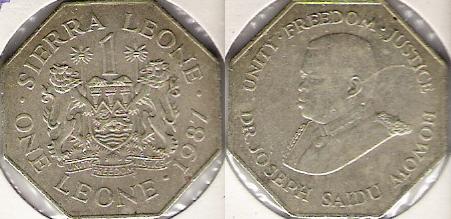
The Leone is the currency of Sierra Leone. It is subdivided into 100 cents. The ISO 4217 code is SLL and the Leone is abbreviated as Le placed before the amount. The leone was introduced in 1964. It replaced the British West African pound at a rate of 1 pound = 2 leones (i.e., 1 leone = 10 shillings).

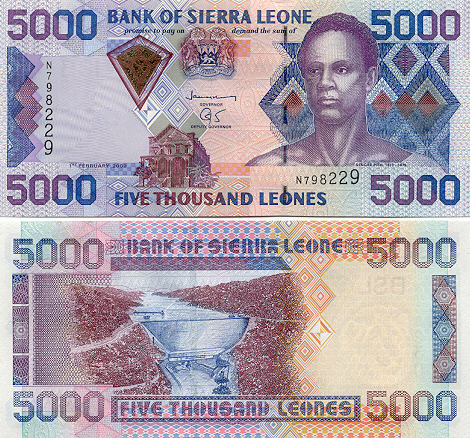
In 1964, the Bank of Sierra Leone introduced notes in denominations of 1, 2 and 5 leones. 50 cents notes were added in 1979, followed by 10 leones in 1980 and 20 leones in 1982. 100 leones notes were introduced in 1988, followed by 500 leones in 1991, 1000 and 5000 leones in 1993, 2000 leones in the year 2000 and 10,000 Leone in 2004.

Prior to June 2010, bank notes in circulation were 500, 1000, 2000, 5000 and 10,000 leones. 10,000 leones notes were in circulation for less than ten years and were infrequently encountered. This meant that most transactions took place in bundles of 5000 leones notes.

In June 2010, the Bank of Sierra Leone issued new notes which were slightly smaller in size than the earlier series and intended to be more secure and durable. The new bank notes are: Le10,000, Le5,000, Le2,000 and Le1,000. Coins are still used, but because of their low value are less common.
Because of inflation, a 20,000 leone banknote has been suggested.


Friday, May 20, 2011

#102: SLSC - Day 12

Day 12: SaLone Style Magazine

SaLone Style magazine was founded by Veronica Conteh in June 2009; it is the first ever magazine that focuses on fashion, beauty and style of Sierra Leoneans as well as Africa as a whole. On September 25, 2009, the magazine was launched to an audience of very important people in the African community in the UK.

To know more about SaLone Style magazine, visit their website (http://www.salonestyle.com/).


#101: Song Challenge - Day 30

Day 30: Your favorite song(s)
Sierra Leone gospel songs

Thursday, May 19, 2011

#100: SLSC - Day 11

Day 11: Mineral resources

Sierra Leone is rich in mineral resources, possessing some of the most commercially valuable mineral reserves in the world, many of which are found in significant quantities. The country has relied on mining, especially diamonds, for its economic base; it is among the top 10 diamond producing nations in the world, and mineral exports remain the main foreign currency earner. Sierra Leone is also among the largest producers of titanium and bauxite, and a major producer of gold. The country has one of the world's largest deposits of rutile. Despite this natural wealth, the vast majority of its people live in poverty.

Due to the fact that Sierra Leone is rich in minerals, the country has relied on mining, especially diamonds, for its economic base. The country is among the top 10 diamond producing nations in the world. Mineral exports remain the main foreign currency earner. Sierra Leone is a major producer of gem-quality diamonds. Though rich in diamonds, it has historically struggled to manage their exploitation and export.

Annual production of Sierra Leone's diamond estimates range between $250–300 million US$. Some of that is smuggled, where it is possibly used for money laundering or financing illicit activities. Formal exports have dramatically improved since the civil war with efforts to improve the management of them having some success. In October 2000, a UN-approved certification system for exporting diamonds from the country was put in place and led to a dramatic increase in legal exports. In 2001, the government created a mining community development fund (DACDF), which returns a portion of diamond export taxes to diamond mining communities. The fund was created to raise local communities' stake in the legal diamond trade.

Sierra Leone is also known for its blood diamonds that were mined and sold to diamond conglomerates during the civil war, in order to buy the weapons that fuelled the atrocities of the civil war. In the 1970s and early 1980s, economic growth rate slowed because of a decline in the mining sector and increasing corruption among government officials.

Sierra Leone has one of the world's largest deposits of rutile, a titanium ore used as paint pigment and welding rod coatings. Sierra Rutile Limited, owned by a consortium of United States and European investors, began commercial mining operations near the city of Bonthe, in the Southern Province, in early 1979. It was then the largest non-petroleum US investment in West Africa. The export of 88,000 tons realized $75 million in export earnings in 1990. In 1990, the company and the government made a new agreement on the terms of the company's concession in Sierra Leone. Rutile and bauxite mining operations were suspended when rebels invaded the mining sites in 1995, but exports resumed in 2005. The new Mines and Minerals Act was passed by Parliament in November 2009, which aimed to improve concessions management in the Ministry of Mineral Resources. Sierra Leone is an EITI candidate country.


P.S.: Some of this information was gotten from Wikipedia.

#99: Song Challenge - Day 29

Day 29: A song from your childhood
Nah mi Jesus

#98: End of the world

So with all the uproar about the world coming to an end that I've been hearing lately, I wanted to share these awesome videos made by one of my fave Youtubers, JaeTracie. Watch them and share what you think.

Wednesday, May 18, 2011

#97: SLSC - Day 10

Day 10: Rujizzle reflects

Lately I've started thinking of how much Sierra Leonean pride I have and get excited about my country. It got me thinking if I lived in the country, if my pride and joy for Sierra Leone would have been the same. When I was living in Sierra Leone, I absolutely loved the country and culture but I do not remember being this patriotic at all. But on the other end, I lived in Sierra Leone when I was younger and below age 12, so there was not much for me to have done which were life-changing actions for the country. However with the resources technology has provided in today's society, younger kids can achieve excellence and age is not an issue.

My big curiousity right now is that if I currently lived in Sierra Leone, if I'd have been so passionate about the nation as I am living outside the nation. I have always had pride for my country because I participated in a lot of social and cultural events that told Sierra Leonean stories in forms of dance and plays, but during those times I never felt a need to but purely did it for entertainment purposes. But now, I have come to realize that several things I do for Sierra Leone are not only for entertainment purposes but also educational purposes. A part of me sometimes feels obligated to tell the stories of Sierra Leoneans, and I really do not have a problem with that. I wonder if I am the only person part of the diaspora that feels that way.

Yes, I still do performances and educational sessions about Sierra Leone and enjoy them just as I did when I was 10, but now I have intentions of also educating the world about my home and telling alternative stories of my country besides the ones that are told on CNN and other international sources.

However, if there is one thing I'd like to change about the nation with regards to this consciousness-raising is that patriotism and nation-pride need to be discussed more among the people, especially the younger generation in the country. I felt that I was rarely told of how blessed and great Sierra Leone was when I lived there, and I only came to realize what a great nation it is after I left. Yes, Sierra Leone is not a country that one can live in and think of it as a bed of roses because there are things that need work to be done, however, the things we do have are blessings and we must appreciate them because other countries long and wish to have them.

Sierra Leone gospel songs

#96: Song Challenge - Day 28

Day 28: A song that makes you thankful
Kirk Franklin - Imagine me
Related Posts Plugin for WordPress, Blogger...